As a parent, I look to educate my children as much as possible at home. The level of teaching in some schools is not adequate. I know quite a few parents at my school that have had their children assessed to see what level they are at and have found they are at a lower level than the national average a big shock to all they told.
The key to educating young children at home is making learning fun and starting from as soon as possible to start laying the foundations for early education on which you can further build. For any of you that have tried you will have discovered that teaching children isn’t always an easy task. If you can teach children how to spell words, count, calculate etc. without making it feel like hard work then it can help to inspire them to use the tools you provide them with to self-educate without realising it whilst equally importantly having fun.
Simple tools can help to make this simple and I found a wonderfully large range of products over at Orchard Toys to help me in my mission with my daughters and am thinking ahead as I also plan to use their products to help Mr Squishy with his early learning. At the moment I’m on basics with him. At the tender age of 1.5years old he has recently learnt to show me where his nose, mouth and eyes are, how cute!!!!
I selected 3 of the items from this great site to tell you all about and help me to demonstrate how learning can be made fun.
 Simple to play. Select a board have the letters facing up and then match the letters to make the word. Alternatively, place the letters facing down so they cannot be seen and learn to spell the word phonetically.
This game can be played in various ways allowing for it to be used by a wide age group. This is suitable for ages 3+ (depending on the child). Where children appear keen to learn this can help to encourage them to begin to form short, simple words in a fun way. It’s great to inspire a little competition amongst children. It encourages them to engage their brain and process information faster it also helps to teach them about winning and losing. A bit of healthy competition amongst children is a good thing. I take full advantage of this in weekly meetups with another mother when we teach our daughters the weekly spellings from school.
We made it harder by playing with the letters facing downwards and the board upwards. The children took it in turns to pick a letter until we had formed the word correctly. It’s perfect for testing their memory. This is a great game for little ones and is far better than them sitting in front of a screen. It’s important to encourage children to play educational games and those that help them to build on their social skills.
This game is great to help children recognize letters initially and then progress onto spelling simple 3 and 4 letter words. You can make your own game of recognizing letters at the very beginning before children are ready to form words and once these have been learnt you can follow the instructions to play as the game as it was intended. This is perfect for those that are early readers to help increase their vocabulary. The individual letters can be used to train children to recognize letters as well as to encourage phonetic pronunciation of each as well as words when they progress. Once letters have been learnt you can then test children’s ability to put the letters in alphabetical order too!

Slug in a Jug
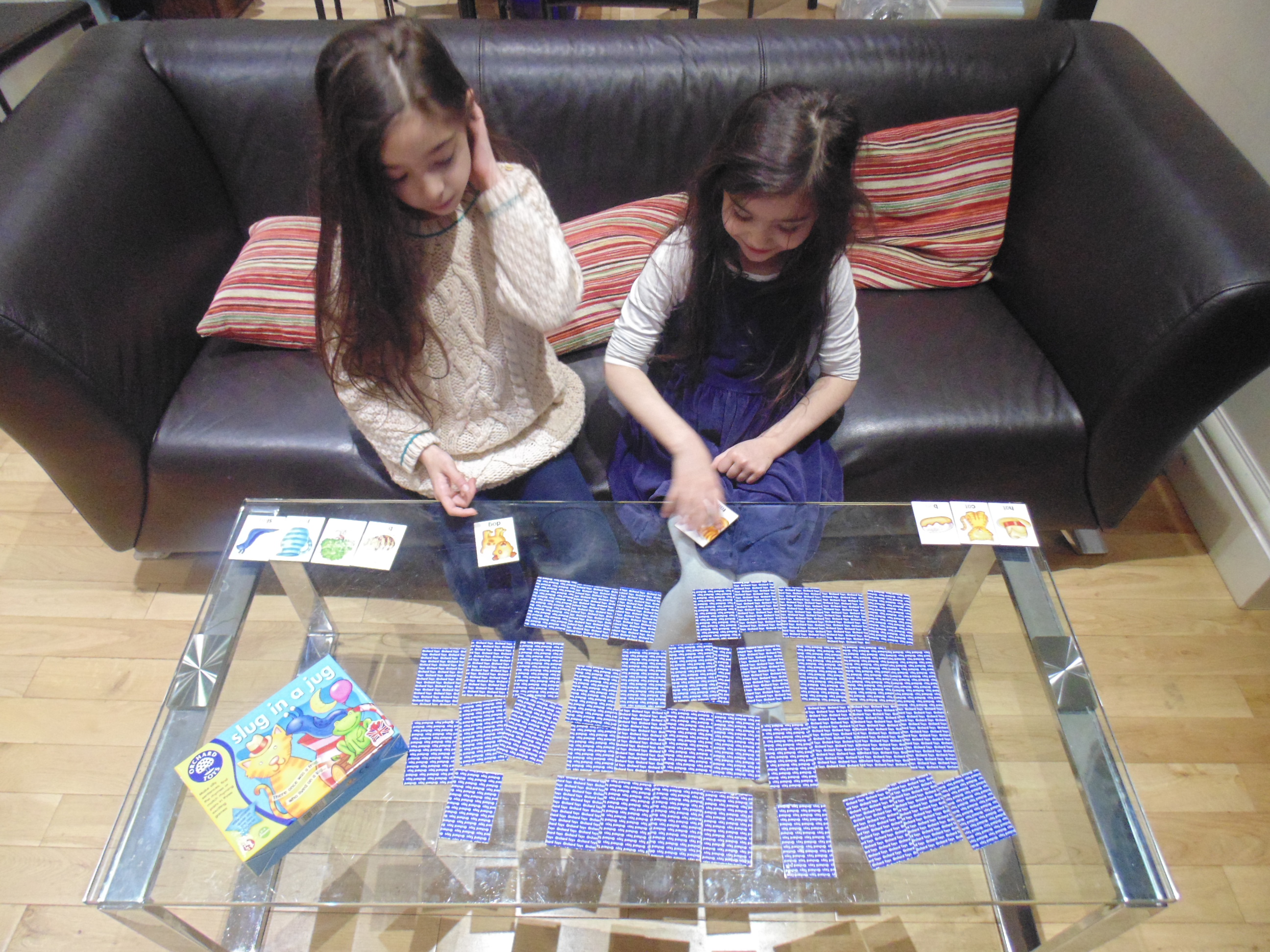 The aim of the game is to collect as many rhyming cards as possible. There are three ways to play which all involve matching the cards players have with a matching rhyming card.
 The games test the child’s understanding of rhyming words and help promote their observational skills as they must identify rhyming pairs from the cards present. Words that rhyme are colour coded to help children with identification. The game helps increase vocabulary. It can be used to help in phonetic pronunciation of words, encourages a lot of discussions and is great fun. The girls loved playing. Once we finished we then tried to add other rhyming words to fit with those already in the game. The girls found the game that used sentences using the rhyming words hilarious. We took it in turns to say our sentence no matter how ridiculous which had the girls in fits of laughter. Again the age suitability depends on the child but it would be suitable from age 4 or 4.5 plus.
Magic Cauldron Game
 The aim to fill your cauldron with magical ingredients first. Whereas the other two games previously mentioned covered English skills this one covers basic maths including simple addition, subtraction and multiplication. The game cards have a sum on one side and a ghost on the other. Players simply answer the question then touch the ghost for a few seconds after which the answer will magically appear. If they have given the correct answer then you can collect a spell ingredient with that number on it.
My 7 year old loved this game so much that she wanted to take it to school on toy day just before we broke up for Easter. This is a great way to teach children the basics in maths. Repetition of the maths questions help to reinforce it in the children’s mind and of course, it’s fun. Children also get to work on their observation skills and interaction with others. This would be best suited for ages 4.5 plus.
 These games are all great for educating children and you don’t need to just follow the game instructions given, you can create your own games too. It’s simple enough to do and can be adapted to your child’s ability. All the games have eye-catching brightly coloured thick pieces with clear numbers and letters. They’re a good size for early learners and look extremely durable, very handy as they are for children.
Like the look of all the games I have mentioned here? What to win them all?
1 lucky winner will get to win each of the great educational games featured on this blog post.
To enter just fill in the Rafflecopter form:
Not sure how to?
Don’t worry just have a quick read of this and see how easy it is:
http://melaniesfabfinds.co.uk/competitions/how-to-enter-rafflecopter-competitions/
Not all of the entry options are compulsory but the more you do the more entries you will gain.
Look out for the daily entry options for extra entries.
Likes on Facebook are NOT compulsory but are very much appreciated plus it will ensure you don’t miss great posts, freebies and competitions.
(Please do not cheat, anyone caught doing so will be disqualified)
For more great giveaways click on the competitions tab at the top of the page. Why not bookmark it as I generally add new competitions each week. Good Luck!!!
*

Discover more from Melanie's Fab Finds
Subscribe to get the latest posts sent to your email.